
IEEPA Tariff Refund: The Complete 2026 Guide for Importers
TL;DR
1. What the SCOTUS Ruling Actually Said
The majority opinion, authored by Chief Justice Roberts, held that IEEPA's text (50 U.S.C. §§ 1701-1708) does not delegate tariff-setting authority to the executive. The statute permits the President to "regulate" international commerce in a declared national emergency, but the Court concluded that imposing ad valorem duties on imports is a revenue-raising power reserved to Congress under Article I, Section 8.
Key holdings:
- IEEPA duties collected between April 2, 2025 and February 20, 2026 are ultra vires and must be refunded.
- Section 232 (steel, aluminum, autos), Section 301 (China List 1-4), and Section 201 (safeguard) duties are not affected by the ruling. Those statutes have independent authority.
- Section 122 (10% balance-of-payments surcharge) survives until its statutory 150-day sunset on July 24, 2026.
- CBP has 270 days from the ruling to complete refund processing under the remedial order.
The ruling does not refund duties voluntarily paid to avoid enforcement on post-ruling entries, nor does it affect antidumping or countervailing duties (AD/CVD).
2. Who Qualifies for an IEEPA Refund
You qualify if all four conditions are met:
- You are the importer of record (IOR) on the entry, or the drawback claimant holding valid assignment.
- The entry was filed between April 2, 2025 and February 20, 2026.
- The entry paid IEEPA duties, identifiable on the CBP Form 7501 line item by the HTSUS Chapter 99 subheading (9903.01.xx series).
- The entry is either (a) still unliquidated, (b) liquidated within 180 days of your CAPE filing, or (c) liquidated earlier but flagged for administrative reliquidation under the CAPE remedial order.
Check the Who Qualifies answer page for a decision tree, or use the AI Analyzer to upload your ACE report and get a qualified/disqualified breakdown by entry.
3. How Much Is Actually Refundable
CBP's April 18 CSMS message (#62104411) estimates the refundable pool at $166 billion across roughly 330,000 active IORs. The median per-importer exposure sits at approximately $112,000, but the distribution is heavily skewed: the top 2,000 importers hold roughly 68% of the refundable duty paid.
Your refundable amount equals:
Sum of (IEEPA duty paid per line) + interest at the CBP quarterly rate from date of deposit to date of refund
Interest compounds quarterly under 19 U.S.C. § 1505(c). For duties paid in Q2 2025 and refunded in Q3 2026, expect approximately 4-5% cumulative interest on top of the principal.
4. The CAPE Portal: What It Is and How It Works
CAPE stands for Consolidated Ad-valorem Protest for Entries. It is a dedicated intake system built on top of the existing ACE (Automated Commercial Environment) platform. It is not a replacement for ACE; it is a refund-specific module accessible to registered ACE portal accounts and licensed customs brokers.
Filing flow:
- ACE account in good standing — the IOR or their broker must have an active ACE Secure Data Portal account with bond on file.
- ACH refund enrollment — refunds issue via ACH credit only. Paper checks are not supported under the CAPE remedial order.
- Entry identification — upload a CSV of entry numbers, or query the CAPE auto-match engine, which cross-references your IOR number against the CBP master ledger of IEEPA-coded entries.
- Declaration — sign the CAPE Declaration (electronic, via ACE PKI), certifying the entries are not duplicate claims, are not subject to pending litigation, and that the duty was actually paid by the claimant.
- Broker certification — if filed by a broker, the broker's Power of Attorney and license number (19 CFR 111.19) are bound to the declaration.
- Submission — CAPE returns a receipt ID and queue position. Phase 1 claims (filed April 20 - July 24, 2026) are processed first.
The CAPE Portal guide has a step-by-step screenshot walkthrough.
5. CF-19 vs CAPE: Which Filing Path Is Yours
There are two parallel refund paths. Most importers will use one. Some will use both.
| Situation | Filing Path | Deadline |
|---|---|---|
| Entry liquidated within last 180 days | CF-19 Protest (traditional) | 180 days from liquidation notice |
| Entry liquidated more than 180 days ago, IEEPA duty paid | CAPE administrative claim | October 16, 2026 (270-day remedial window) |
| Entry still unliquidated with IEEPA charge | Post-Summary Correction (PSC) or CAPE | 300 days from entry or Phase 2 CAPE |
| Substitution or manufacturing drawback tied to IEEPA duty | Drawback claim on CBP Form 7551 | 5 years from import |
If your entry is inside the 180-day post-liquidation window, file a CF-19 protest under 19 U.S.C. § 1514 rather than waiting for CAPE. The CF-19 path is a statutory right; the CAPE path is a remedial administrative grace window that could narrow.
6. Documentation You Need Before You File
Before touching the CAPE portal, assemble:
- ACE entry summary reports for every entry between April 2, 2025 and February 20, 2026.
- Entry-by-entry CBP 7501 line detail showing the 9903.01.xx subheading and the ad valorem duty calculation.
- Commercial invoices and packing lists matching each entry.
- Proof of payment — ACH debit record or single-entry bond ledger.
- Power of Attorney to your broker, if using one (19 CFR 141.31).
- IOR number and bond rider information.
- Any prior CF-28 or CF-29 correspondence on the entries.
The Drawback Estimator can help you cross-check whether a portion of your refund is better pursued as drawback rather than CAPE, especially if the goods were subsequently exported.
7. The Hard Deadlines You Cannot Miss
Four deadlines control everything:
- 180 days post-liquidation — Under 19 U.S.C. § 1514, you lose your CF-19 protest right. This is statutory and cannot be extended. If liquidation occurred October 15, 2025, your protest must be filed by April 13, 2026. Gone is gone.
- October 16, 2026 — End of CBP's 270-day remedial window under the Court order. CAPE Phase 1 closes.
- July 24, 2026 — Section 122 10% surcharge sunset. Not an IEEPA deadline, but relevant to parallel filings on the same entries.
- Five years from date of import — Outer bound for substitution and manufacturing drawback claims under 19 U.S.C. § 1313.
Miss the 180-day window on a liquidated entry and your only remaining path is the CAPE remedial window. Miss CAPE and your only path is Court of International Trade litigation, which most importers will not find economical.
8. Common Mistakes That Kill Refunds
From reviewing early Phase 1 CAPE filings, the top failures are:
- Wrong HTSUS lookup. Filers self-identifying IEEPA duty by searching for "IEEPA" in ACE get zero hits. The duty is coded in HTSUS Chapter 99 (9903.01.xx), not labeled IEEPA.
- Double-filing CF-19 and CAPE on the same entry. CAPE rejects as duplicate. Pick one path per entry.
- Unsigned declaration. CAPE electronic signature requires ACE PKI, not a DocuSign scan.
- Broker filing without POA on file. CBP will suspend the claim and issue a deficiency notice; the 180-day clock does not pause during the deficiency cure period.
- Treating antidumping duties as refundable. AD/CVD duties under 19 U.S.C. § 1673 are not IEEPA and do not refund.
- Missing ACH enrollment. Refunds cannot issue without it, and the 270-day clock keeps running while you enroll.
9. Working With a Licensed Customs Broker
Under 19 U.S.C. § 1641 and 19 CFR 111, only a licensed customs broker may transact customs business on behalf of a third party for compensation. CAPE filings are customs business. If a consultant offers to file your CAPE claim directly without broker involvement, that is unauthorized practice and exposes both parties to civil penalties under 19 CFR 111.91.
The compliant model: consultants and technology platforms (including Tariff Refund Credits) identify eligible entries, prepare documentation, and calculate refunds. A partner licensed customs broker files the CAPE declaration and signs under their license. See Broker vs Consultant for the 19 USC 1641 breakdown.
10. Recommended Filing Sequence
For an importer with multi-year exposure across IEEPA, Section 301, and drawback-eligible inventory:
- Pull ACE entry summary for April 2, 2025 through February 20, 2026.
- Identify 9903.01.xx line items and calculate IEEPA duty paid per entry.
- Determine liquidation status per entry.
- File CF-19 protest on every entry still inside its 180-day window.
- Queue CAPE filings for liquidated entries outside the 180-day window.
- Separately, pull export records for the last five years and evaluate substitution drawback for Section 301 duty.
- Confirm ACH enrollment and bond sufficiency before Phase 1 CAPE submission.
Use the IEEPA Refund Calculator to model the refund before you file.
Frequently Asked Questions
<script type="application/ld+json"> { "@context": "https://schema.org", "@type": "FAQPage", "mainEntity": [ { "@type": "Question", "name": "Is the IEEPA tariff refund automatic?", "acceptedAnswer": {"@type": "Answer", "text": "No. CBP requires every refund to be affirmatively claimed through either a CF-19 protest or a CAPE administrative filing. Refunds do not auto-issue from the SCOTUS ruling."} }, { "@type": "Question", "name": "Do I need a customs broker to file a CAPE claim?", "acceptedAnswer": {"@type": "Answer", "text": "Not if you are filing on your own entries as the importer of record. If a third party files for you for compensation, that third party must be a licensed customs broker under 19 USC 1641 and 19 CFR 111."} }, { "@type": "Question", "name": "What if my entry is still unliquidated?", "acceptedAnswer": {"@type": "Answer", "text": "You may file a Post-Summary Correction (PSC) within 300 days of entry or wait for liquidation and file a CF-19 protest within 180 days. CAPE Phase 2 will also accept unliquidated entries once Phase 1 clears."} }, { "@type": "Question", "name": "Does the refund include interest?", "acceptedAnswer": {"@type": "Answer", "text": "Yes. Under 19 USC 1505(c), CBP pays interest at the quarterly published rate from date of duty deposit to date of refund, compounded quarterly."} }, { "@type": "Question", "name": "Are Section 301 China duties refundable under this ruling?", "acceptedAnswer": {"@type": "Answer", "text": "No. Section 301 authority under 19 USC 2411 is independent of IEEPA. The SCOTUS ruling vacated only IEEPA-based duties. Section 301 List 1-4 duties remain in effect."} } ] } </script>Q: Is the IEEPA tariff refund automatic? No. CBP requires every refund to be affirmatively claimed through either a CF-19 protest or a CAPE administrative filing.
Q: Do I need a customs broker to file a CAPE claim? Not if you are filing on your own entries as the IOR. If a third party files for you for compensation, that party must be a licensed customs broker.
Q: What if my entry is still unliquidated? File a Post-Summary Correction within 300 days of entry, or wait for liquidation and file a CF-19 within 180 days.
Q: Does the refund include interest? Yes, at the CBP quarterly rate, compounded quarterly, from date of deposit to date of refund.
Q: Are Section 301 China duties refundable under this ruling? No. Section 301 has independent statutory authority and is not affected.
Ready to file? Start with the IEEPA Refund Calculator, upload your ACE report to the AI Analyzer, or book a consult with our licensed customs broker partner.
Reviewed by Licensed Customs Broker Partner (pending name). Last updated April 22, 2026. This guide is educational and does not constitute legal or customs advice. Filing decisions should be made in consultation with a licensed customs broker and, where appropriate, counsel. Tariff Refund Credits is not a law firm and does not transact customs business directly; all CAPE and CF-19 filings are executed by our partner licensed customs broker under 19 USC 1641.
Keep reading
qualification decision tree
Quick eligibility check before you file.
Read more →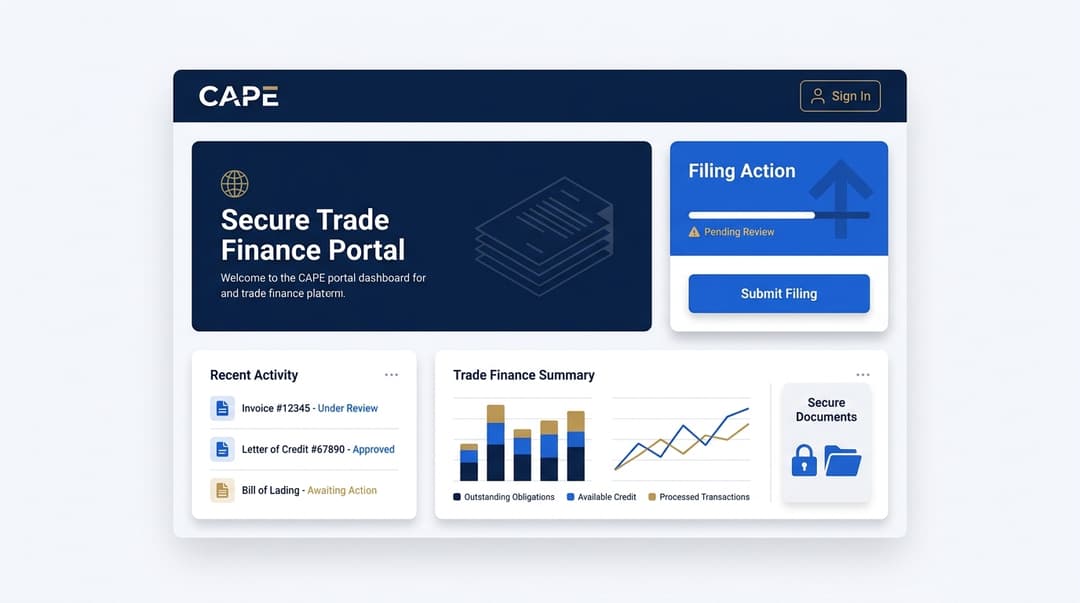
CAPE portal walkthrough
Step-by-step filing inside CAPE Phase 1.
Read more →
Learning Resources SCOTUS opinion summary
Holding that triggered the refund window.
Read more →
180-day CF-19 protest mechanics
Statutory deadline that runs in parallel to CAPE.
Read more →
Section 122 surcharge parallel deadline
Related sunset deadline running alongside CAPE.
Read more →
California state-level filing context
State-specific CAPE filing notes for CA.
Read more →Frequently asked questions
Ready to recover?
Run the calculator or take the 60-second qualification quiz. Estimate only — subject to CBP adjudication.